Reverse osmosis vs. pitcher filter: which do you need?
Last reviewed 2026-11-25.
By Luke Walker, editor (editorial policy). He is not a laboratory scientist, a licensed water-treatment professional, or a public-health official. Facts on this page come from the official sources cited below.
A pitcher is a simple cartridge you fill by hand. Reverse osmosis is usually an under-sink membrane system that can reduce a wider set of dissolved contaminants when it is certified for them. Neither is automatically better: match the certified claim to your test result.
Test first, then treat. The right system depends on what is actually in your water. On a private well, use a state-certified lab (see what to test for). On city water, read your utility’s annual water quality report (Consumer Confidence Report). Already have results? See what your water test results mean.
How they differ
Pitcher filters and reverse osmosis at a glance
Pitcher filter
Reverse osmosis
How it works
You pour water through a replaceable cartridge, usually carbon and sometimes ion-exchange media.
Water is pushed through a semipermeable membrane, often with carbon stages before and after, usually under the sink to a separate faucet.
What it can be certified for
Commonly NSF/ANSI 42 (chlorine, taste, odor) and, on some models, NSF/ANSI 53 (lead or other listed claims) or a PFAS claim.
NSF/ANSI 58 for RO, often including TDS; many units also carry 42, 53, 401 or a PFAS claim for the system as listed.
Typical gaps
Usually not nitrate, arsenic, salts or bacteria. Certification is model-specific.
Does not treat the whole house, sends some water to the drain, and does not disinfect unless paired with another device. Not a substitute for a lab test.
Upkeep
Replace the cartridge on the maker’s schedule, or sooner if flow or taste drops.
Replace prefilters, the membrane and the faucet filter on the maker’s schedule; sanitize as instructed; retest the treated water.
Certification is claim by claim. A box that says “NSF/ANSI 53” may be certified only for cyst reduction, not lead or PFAS. Look up the exact model in a certifier’s listing (NSF, WQA, IAPMO, UL or CSA) and match the contaminant on the performance data sheet. See what each NSF/ANSI standard covers.
When a pitcher is enough
A pitcher is often enough for chlorine taste and odor on city water, and it can be enough for lead or PFOA/PFOS when that exact cartridge is certified for those claims. EPA’s consumer tools list pitcher and other point-of-use filters certified to reduce lead or PFAS. Look up the model before you buy, and replace the cartridge so the claim still applies.
A pitcher will not protect showers or cooking water from the main tap, and it is the wrong tool for nitrate, arsenic or a bacteria problem.
Example: an under-sink reverse osmosis system
Sponsored
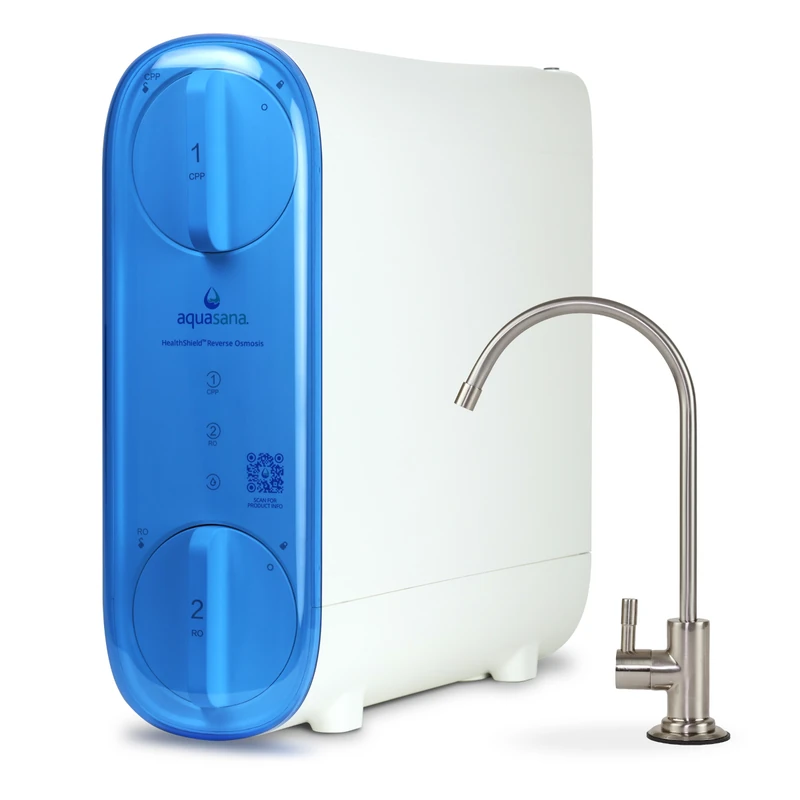
We do not currently list a pitcher filter. This is an example of under-sink RO. Aquasana states the system is certified for lead reduction; confirm the official listing for the claims that match your test result. For certified pitchers, use EPA’s consumer tools linked in Sources.
Certification stated on Aquasana’s HealthShield Reverse Osmosis product page, checked November 23, 2026.
We may earn a commission from these links at no extra cost to you. Learn more
When reverse osmosis is the better fit
Choose RO at the drinking and cooking tap when a certified lab result (or, on city water, a water-quality report) shows dissolved contaminants a pitcher is not certified to reduce. That often includes nitrate, arsenic, fluoride and high dissolved solids, and it can include lead or PFAS when the RO system’s listing covers those claims.
RO is not a whole-house solution and it is not a disinfectant. For hardness, iron, sulfur odor or bacteria, see the matching guides rather than expecting the membrane to do that work. More detail on each system type is in types of water filters compared.
How to decide
Test first, or read your utility’s annual report.
List the contaminants you actually need to reduce.
Choose a product whose official listing names those contaminants, whether that is a pitcher, another carbon filter or reverse osmosis.
Retest the water you drink after the system is installed.
Frequently asked questions
Is reverse osmosis better than a pitcher filter?
Reverse osmosis can reduce a wider range of dissolved contaminants when the system is certified for them, including some things most pitchers cannot, such as nitrate. A pitcher is simpler, cheaper to run and can still be the right choice when it is certified for the problem you actually have, such as chlorine taste or, if listed, lead or PFOA/PFOS.
Will a pitcher filter remove lead or PFAS?
Only if that exact pitcher and cartridge are certified to reduce lead (NSF/ANSI 53) or PFOA/PFOS or total PFAS, as shown in a certifier’s listing and the performance data sheet. Many pitchers are certified only for taste and chlorine (NSF/ANSI 42). EPA publishes tools for identifying lead- and PFAS-reduction filters, including pitchers.
Does a pitcher filter remove nitrate?
A typical carbon pitcher is not a nitrate treatment. Reverse osmosis, anion exchange or distillation can reduce nitrate when they are certified or designed for that job. Boiling makes nitrate worse. See our nitrate guide.
Do I need reverse osmosis if I already have a pitcher?
Not automatically. If a certified lab test or your water-quality report only shows a problem your pitcher is certified to reduce, you may not need RO. If the test shows dissolved contaminants a pitcher is not certified for, such as nitrate, arsenic or high dissolved solids, an under-sink RO system certified for those claims is the usual next step at the drinking tap.
More water treatment guides
General information, not medical advice or a diagnosis, and not legal advice. For a result that worries you, call your local or state health department or a licensed water treatment professional, and retest after any treatment is installed. See our disclaimer.